








Viktualienmarkt München is a permanent open-air food market in Munich’s Old Town, close to Marienplatz and surrounded by some of the city’s most recognizable historic sights. The market contains roughly 140 stalls and traders according to its official website, although Munich Tourism commonly describes around 100 market stalls depending on how the businesses and trading areas are counted. Visitors can find everything from fruit and vegetables to fish, meat, bread, spices, cheese, flowers and specialty foods. There are also places where you can eat and drink rather than simply shop.
Where Is Viktualienmarkt in Munich?
Viktualienmarkt is located in Munich’s central Altstadt, making it particularly convenient for visitors exploring the city on foot. It sits only a short walk from Marienplatz, with the market extending around the Heilig-Geist-Kirche, Frauenstraße, Petersbergl and surrounding streets. The location is one of its biggest advantages because you can easily combine a visit with other central Munich attractions such as the Neues Rathaus, St. Peter’s Church and the pedestrian shopping area.
A Short History of Viktualienmarkt München
The story of Viktualienmarkt begins in 1807, when King Max I Joseph ordered an area between the Heilig-Geist Church and Frauenstraße to be used as a dedicated market space because the market at nearby Marienplatz had become too crowded. The market was initially known simply as Marktplatz, while the word “Viktualien” came later from a Latin-derived term for food. During the 19th century, the market continued to expand, adding different halls and selling areas, and by around 1890 it had reached approximately its present size.
Why Is It Called Viktualienmarkt?
The name sounds unusual if you are unfamiliar with German, but its meaning is quite straightforward. “Viktualien” is an old word connected with food and provisions, derived from the Latin word “victus.” The name reflects the market’s original and continuing purpose: bringing food and everyday provisions together in the centre of Munich. Over time, the simple market developed into a much broader food destination while retaining its traditional character.
What Can You Buy at Viktualienmarkt?
One of the best things about the market is the sheer variety available in a relatively small area. Depending on the stall, shoppers can find seasonal fruit and vegetables, fresh herbs, meat, poultry, fish, cheese, bread, pastries, honey, spices, delicatessen foods, flowers and specialty products. Some stalls focus heavily on traditional German and Bavarian ingredients, while others bring international flavours into the market. This combination means you can visit with a shopping list or simply wander around and see what catches your attention.
Bavarian Food to Try at Viktualienmarkt
For visitors interested in Bavarian cuisine, the market provides plenty of opportunities to try familiar local foods without sitting down for a long restaurant meal. A Leberkas roll, Bavarian pretzels, Obatzda, soups and other traditional snacks are among the kinds of foods available around the market. The official Munich tourism guide also highlights Auszogne, a traditional fried pastry, as another Bavarian specialty worth discovering. The experience is especially enjoyable when you choose something small, eat while walking and then stop for coffee or a drink afterward.
Breakfast at Viktualienmarkt München
Morning is one of the most atmospheric times to visit because the market gradually comes to life as traders open their stalls and prepare fresh products for the day. Bakeries and cafés provide opportunities for coffee, bread and pastries, while some visitors prefer to start with a traditional pretzel. The official market information notes that the first stall opens very early, while most stalls generally begin opening between around 7 and 10 a.m., so early visitors can experience a quieter side of the market before the busier daytime period.
Lunch at Viktualienmarkt
Lunchtime brings a different atmosphere, with office workers, locals and tourists stopping by for something quick to eat. You can pick up a Leberkas roll, soup, curry, fish or another warm snack and continue exploring without committing to a formal restaurant meal. The surrounding cafés and restaurants also offer additional choices if you want to sit down for longer. This makes Viktualienmarkt particularly useful for travellers who want to combine sightseeing with a casual local food experience.
The Viktualienmarkt Beer Garden
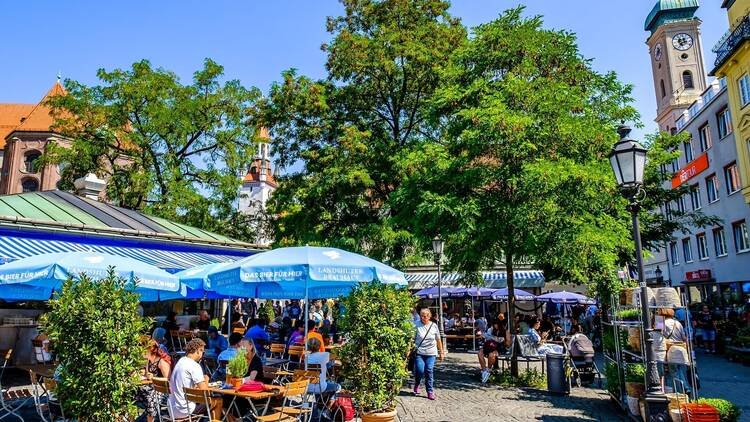
At the centre of the market is a large traditional beer garden beneath chestnut trees. It has around 1,100 seats and offers a classic Munich beer-garden setting surrounded by the activity of the market. One unusual feature is that the beer served changes between Munich’s major breweries rather than remaining with a single brewery throughout the year. The official market website lists Hofbräu, Spaten, Augustiner, Hacker-Pschorr, Paulaner and Löwenbräu among the breweries that rotate through the beer garden.
Can You Bring Your Own Food to the Beer Garden?
Yes, the Viktualienmarkt beer garden follows the traditional Munich beer-garden custom that allows visitors to bring their own food while buying drinks from the beer garden. You can also purchase food from the surrounding market stalls and enjoy it at the beer garden. That makes the area particularly convenient because you can choose your food from different vendors instead of being limited to one restaurant menu.
The Famous Maypole at Viktualienmarkt
The tall Maibaum, or maypole, is one of the most recognizable features of Viktualienmarkt München. Munich’s first market maypole was erected by the city’s breweries in 1962 after the idea was promoted by former Munich third mayor Albert Bayerle. Its decorative figures represent elements of Munich and Bavarian life, including brewing, Oktoberfest traditions, musicians, dancing, market traders and the patron saints of brewers. The current maypole is listed by the market as 34.5 metres tall and was erected in 2022.
The Historic Fountains
Another detail that makes the market more than an ordinary food shopping area is its collection of fountains featuring Munich personalities. Visitors can find fountains dedicated to figures such as Karl Valentin, Liesl Karlstadt, Weiß Ferdl, Ida Schumacher, Elise Aulinger and Roider Jackl. These monuments add a strong local character to the market and provide interesting details to look for while walking between the stalls. In August, the traditional fountain festival brings decorated fountains, music and performances to the area.
How the Market Is Organized
Viktualienmarkt is divided into seven sections, although the individual sections are not necessarily marked with prominent signs for visitors. Different areas have different specialties, including fruit and vegetables, flowers, bakeries, butchers, fish, poultry and delicatessen products. The central section contains the beer garden and Maypole, while other sections extend toward Heilig-Geist-Kirche, Frauenstraße and Petersbergl below St. Peter’s Church. Knowing this layout can make the market easier to explore because you can gradually move from one area to another instead of treating it as one large undivided space.
What Makes Viktualienmarkt Different From a Regular Market?
A supermarket is designed to help you shop quickly, while Viktualienmarkt is much more about discovery and atmosphere. You hear conversations between traders and customers, smell freshly baked food, see colourful produce and encounter traditional Munich symbols as you walk around. The market also mixes everyday shopping with tourism, so you may see a local buying ingredients for dinner beside visitors trying Bavarian food for the first time. That mixture of ordinary life and sightseeing is a big part of its appeal.
Best Time to Visit Viktualienmarkt München
The best time depends on what you want from the experience. A morning visit can feel calmer and gives you a chance to see the market opening and explore food stalls before the busiest periods. Around lunchtime, the market becomes more energetic as people arrive for quick meals and the beer garden becomes especially popular. If you mainly want photographs and a relaxed walk, earlier in the day can be more comfortable, while food lovers may enjoy visiting around breakfast or lunch when many stalls and food options are active.
Viktualienmarkt Opening Hours
The market square itself is a public space and remains accessible around the clock, but individual stalls have their own operating schedules. In general, market stalls operate from Monday to Saturday, commonly opening around 8 a.m. and closing by 8 p.m. at the latest, although some traders open earlier or close earlier, particularly during winter. Sundays and public holidays are different because most regular market stalls are closed, so visitors should not assume that seeing the open square means all vendors will be trading.
Is Viktualienmarkt Open on Sunday?
The Viktualienmarkt area itself is open on Sundays because it is a public square, but the regular market stalls are generally closed on Sundays and public holidays. Certain businesses such as some bakeries, florists and food establishments may have different schedules, and the beer garden can also open on Sundays when conditions are suitable. If your main goal is to browse the full range of market stalls, Monday through Saturday is the safer choice.
How Much Time Do You Need at Viktualienmarkt?
You can see the main sights in about an hour, but giving yourself two or three hours makes the visit much more enjoyable. That gives you enough time to walk through the different sections, stop at a few food stalls, look at the fountains and Maypole, take photographs and sit down for a drink or snack. If you are particularly interested in food shopping, you could easily spend longer because there are many different vendors and products to explore. The market is compact enough for a short visit but interesting enough to reward a slower pace.
What Should You Look For on Your First Visit?
Start by walking around without immediately buying anything. Look at the fresh produce, notice the different specialty stalls and find the central Maypole and beer garden. Then choose one or two Bavarian foods to try rather than attempting to eat everything at once. Afterward, explore the fountains and surrounding streets, especially the areas near St. Peter’s Church and Heilig-Geist-Kirche. This simple approach gives you a better sense of the market instead of turning the visit into a rushed checklist.
Viktualienmarkt and Munich’s Food Culture
The market gives visitors a compact introduction to Munich’s food traditions because it combines ingredients, prepared food and social spaces in one place. Munich Tourism describes it as a culinary centre of the Old Town, with everything from traditional Bavarian delicacies to more exotic produce. Regional suppliers also contribute to the market’s food culture, with examples including local herb growers, cheese producers and established fish and bakery businesses.
Nearby Attractions to Visit
One reason Viktualienmarkt works so well in a Munich itinerary is its central location. After exploring the market, you can walk toward Marienplatz, admire Munich’s historic town hall, visit St. Peter’s Church or continue through the Old Town pedestrian area. The market is also close to other well-known attractions, meaning you do not need to dedicate an entire day to it. Instead, it fits naturally into a walking tour of central Munich.
Viktualienmarkt for Food Photography
The market is naturally photogenic because of its colourful produce, flowers, traditional architecture, fountains, Maypole and busy food stalls. Early morning light can create a quieter atmosphere, while midday gives photographs a stronger sense of everyday market life. If you are photographing people or individual traders rather than simply taking general market pictures, it is sensible to be respectful and ask permission when appropriate. The market’s visual variety means you can capture much more than typical tourist landmark photographs.
Is Viktualienmarkt Worth Visiting?
For travellers interested in Munich’s food, traditions and everyday city life, Viktualienmarkt offers a particularly concentrated experience. It combines a historic market, specialty food stalls, Bavarian snacks, a beer garden, fountains and the famous Maypole within the Old Town. It is also flexible: you can visit for 30 minutes while sightseeing, spend an hour trying local food or stay much longer for shopping and a relaxed meal.
Tips for Visiting Viktualienmarkt München
Visit Monday through Saturday if you want to experience the regular market stalls, arrive earlier if you prefer a calmer atmosphere, and allow extra time if you want to eat at the beer garden. Individual vendors set their own hours, so a particular stall may not follow the general market schedule. It is also worth checking the official opening information around public holidays and special dates because operating hours can change. Most importantly, do not rush through the market; part of the experience is simply wandering between stalls and seeing what looks interesting.
Conclusion
Viktualienmarkt München is one of those places where a simple food market becomes part of the identity of a city. Its history reaches back to 1807, but the experience feels alive rather than preserved behind glass. Locals still shop there, visitors come for Bavarian specialties, the beer garden provides a place to relax and the Maypole and fountains add layers of Munich tradition. Whether you are visiting Munich for the first time or returning for another trip, spending some time at Viktualienmarkt can give you a more everyday and food-focused view of the city.
Frequently Asked Questions About Viktualienmarkt München
What is Viktualienmarkt München famous for?
Viktualienmarkt is famous for its historic open-air food market, large selection of fresh and specialty foods, central beer garden, traditional Maypole and fountains dedicated to Munich personalities. It is located in the heart of Munich’s Old Town and has been an important market site since 1807.
What are the opening hours of Viktualienmarkt?
Most regular market stalls generally open from around 8 a.m. and close by 8 p.m. from Monday to Saturday, although individual traders choose their own hours. Some stalls open earlier, while some may close earlier in winter. The market square itself is open 24 hours because it is a public space.
Is Viktualienmarkt open on Sundays?
The market area remains accessible on Sunday, but most regular market stalls are closed on Sundays and public holidays. Some bakeries, florists, food businesses and the beer garden may have separate Sunday schedules, so visitors should check individual opening times if they have a specific place in mind.
What food should you try at Viktualienmarkt?
Visitors can try traditional Bavarian foods such as Leberkas rolls, pretzels, Obatzda, soups and regional pastries, along with fish, cheese, delicatessen products and other international foods. A good strategy is to choose a few small items from different stalls rather than having one large meal.
Does Viktualienmarkt have a beer garden?
Yes. The market has a large beer garden beneath chestnut trees with around 1,100 seats. Munich’s major breweries rotate the beer selection, and the beer garden follows the traditional Munich custom that visitors can bring their own food while purchasing drinks from the beer garden.
One thought on “Viktualienmarkt München Munich’s Famous Food Market”