







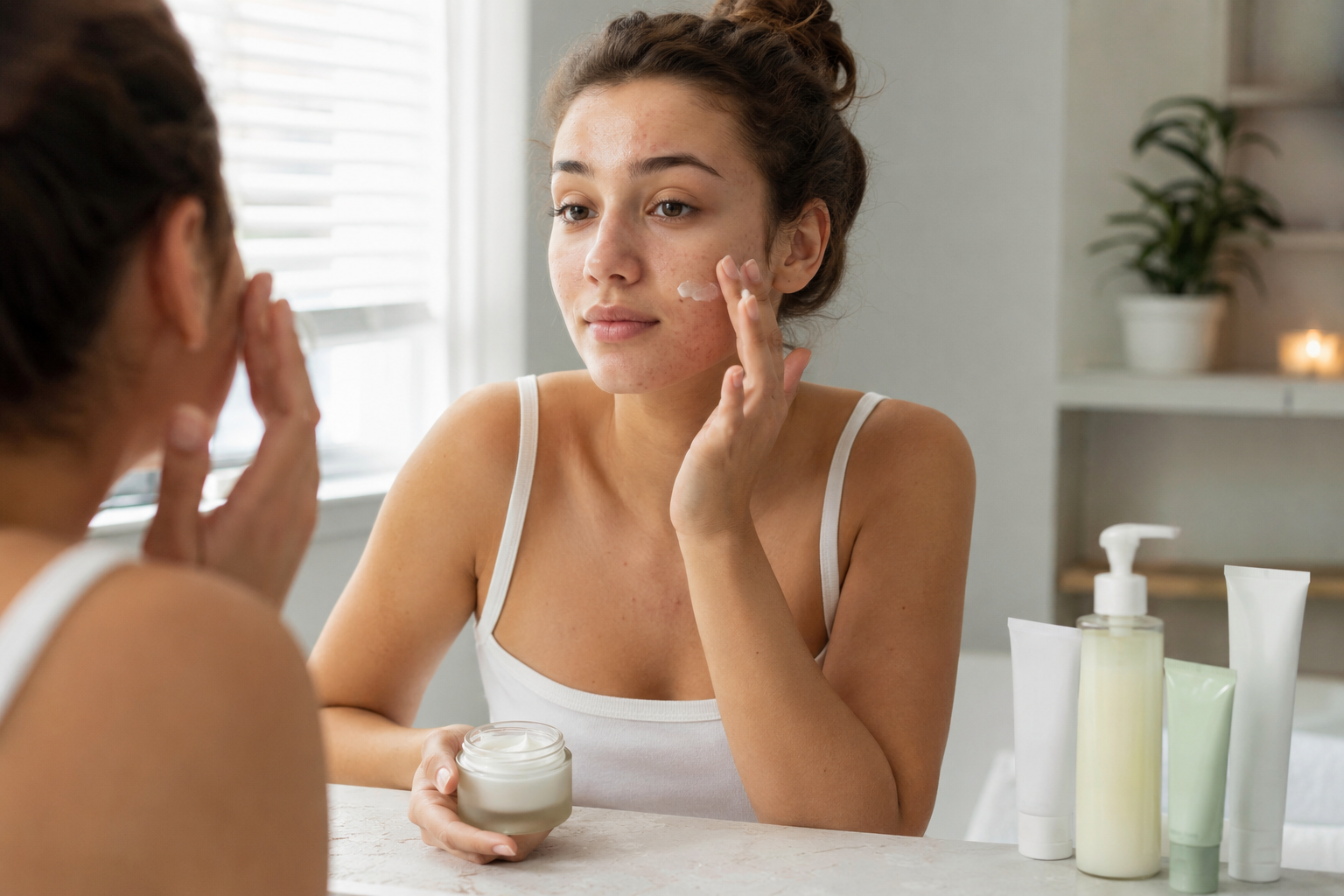
The best skincare routine for combination acne-prone skin, including cleanser, acne treatments, moisturizer, sunscreen, and common mistakes. Combination skin generally means that different areas of your face behave differently. Your forehead, nose, and chin may produce more oil, while your cheeks or the area around your mouth may feel normal or dry. When acne is added to the picture, you have to control clogged pores and breakouts without stripping the skin’s more delicate areas.
This is why using an aggressive cleanser or several strong exfoliants can backfire. A product that makes your T-zone feel extremely clean may leave your cheeks irritated and uncomfortable. Gentle skincare is generally a better foundation for acne-prone skin because irritation itself can make breakouts harder to manage.
What Is the Best Skincare Routine for Combination Acne-Prone Skin?
The best routine is one that balances oil control, hydration, acne treatment, and sun protection without overwhelming your skin. In the morning, use a gentle cleanser, lightweight moisturizer, and SPF 30 or higher sunscreen. At night, cleanse again, use one appropriate acne treatment, and finish with moisturizer.
You do not need a dozen products to have an effective routine. In fact, starting with fewer products makes it easier to see how your skin responds and reduces the chance of unnecessary irritation.
Morning Skincare Routine
Step 1: Start With a Gentle Cleanser
Begin your morning with a gentle cleanser that removes excess oil, sweat, and residue without leaving your face feeling tight. A mild foaming cleanser can work well if your T-zone becomes oily, while a gentler hydrating cleanser may be preferable if your cheeks are easily irritated.
The goal is not to remove every trace of oil. Your skin needs some natural lipids to maintain its protective barrier. Dermatologists recommend gentle, non-abrasive cleansing rather than trying to scrub acne or oil away.
Step 2: Add an Acne-Friendly Treatment if Needed
If you have frequent clogged pores, blackheads, whiteheads, or acne marks, you can add a targeted treatment after cleansing. Options include ingredients such as azelaic acid or salicylic acid, depending on your particular concerns.
Azelaic acid can be especially useful when acne and post-acne dark spots occur together, while salicylic acid can help unclog pores and is particularly useful for blackheads and whiteheads.
If you are new to active ingredients, there is no need to introduce several of them at once. Start with one and give your skin time to adjust.
Step 3: Use a Lightweight Moisturizer
This is the step people with oily or combination skin often want to skip, but moisturizer still matters. Acne treatments can dry and irritate the skin, and a suitable moisturizer can help your skin tolerate those treatments.
Look for an oil-free, non-comedogenic moisturizer that feels comfortable on your face. Ingredients such as ceramides and hyaluronic acid can be useful when combination skin needs hydration without a heavy finish.
Step 4: Finish With Sunscreen
Apply a broad-spectrum sunscreen with SPF 30 or higher every morning. This becomes especially important when you are treating acne because sun exposure can contribute to lingering discoloration, while some acne treatments can increase sensitivity to sunlight.
For acne-prone skin, look for a sunscreen labeled non-comedogenic or “won’t clog pores.” A lightweight fluid or gel formula may also feel more comfortable if your T-zone becomes greasy during the day.
Night Skincare Routine
Step 1: Cleanse Away the Day
At night, gently wash away sunscreen, makeup, sweat, and accumulated oil. If you wear makeup or a water-resistant sunscreen, make sure it is thoroughly removed before applying your acne treatment.
Avoid scrubbing aggressively. Your cleanser should leave your face clean, not squeaky, burning, or unusually tight.
Step 2: Choose One Main Acne Treatment
Nighttime is often the easiest place to introduce an acne treatment. The right active ingredient depends on the type of acne you experience.
Adapalene, a topical retinoid, can help unclog pores and treat blackheads, whiteheads, and pimples. Benzoyl peroxide is another established acne treatment, particularly useful for inflammatory pimples. Salicylic acid can help with clogged pores, while azelaic acid can address acne and post-inflammatory dark spots.
The important part is not to throw all of these ingredients into the same routine immediately. Choose an appropriate starting treatment and follow its directions.
Step 3: Moisturize Again
Finish your evening routine with moisturizer. If your cheeks become dry but your T-zone stays oily, you can use a lighter layer over the oily areas and a slightly more generous amount on the drier areas.
This does not mean you need two completely different routines. Combination skin often responds well to simply adjusting how much moisturizer you use in different areas.
How Often Should You Use Acne Treatments?
Start slowly, particularly if your skin is sensitive or you have never used an acne treatment before. Some topical treatments can cause dryness, peeling, burning, or irritation when introduced too quickly.
NICE recommends considering alternate-day or short-contact application when starting topical retinoids or benzoyl peroxide to reduce irritation, then increasing use as tolerated.
Rather than judging a product after two or three days, give an appropriate acne treatment time to work. The American Academy of Dermatology notes that people using an over-the-counter acne treatment should generally use it as directed for around six to eight weeks before deciding whether it is helping, unless significant irritation occurs.
A Simple Weekly Routine for Beginners
If you are completely new to acne skincare, keep the first few weeks simple. Use a gentle cleanser, moisturizer, and sunscreen consistently, then introduce one acne active rather than changing everything at the same time.
For example, you might use your chosen acne treatment on Monday, Wednesday, and Friday evenings initially, with cleanser and moisturizer on the other nights. If your skin remains comfortable, you can gradually follow the product’s recommended frequency.
This approach makes it easier to identify what works and what causes irritation.
Which Ingredients Are Best for Combination Acne-Prone Skin?
Adapalene
Adapalene is a topical retinoid that helps prevent clogged pores and can treat several common forms of acne. It can be particularly useful when blackheads, whiteheads, and recurring pimples are part of the problem.
Benzoyl Peroxide
Benzoyl peroxide is commonly used for inflammatory acne and works by reducing acne-causing bacteria on the skin. If you are starting with an over-the-counter product, the AAD recommends considering 2.5% rather than immediately choosing a stronger concentration because higher strengths can cause more irritation.
Salicylic Acid
Salicylic acid can help exfoliate inside pores and is particularly useful for blackheads and whiteheads. However, using it too frequently can make already-dry areas uncomfortable, so combination skin may benefit from using it selectively or less often.
Azelaic Acid
Azelaic acid is another useful option when acne and dark marks are both concerns. It can help treat acne while also addressing the discoloration that can remain after a breakout.
How to Moisturize Combination Acne-Prone Skin
Moisturizing combination skin is about finding the middle ground. You do not want a heavy product that makes your T-zone feel greasy, but you also do not want to leave dry areas unprotected.
A lightweight lotion or gel-cream can be a good starting point. Look for terms such as non-comedogenic, oil-free, or “won’t clog pores.” Ceramides and hyaluronic acid are ingredients that can support hydration, while fragrance-free options may be preferable if your skin is easily irritated.
Do You Need a Toner?
No, a toner is not an essential step in an acne routine. If you enjoy using one and it is gentle and non-irritating, it can be included, but it should not replace cleanser, moisturizer, sunscreen, or an appropriate acne treatment.
Alcohol-heavy toners and products that leave your skin stinging are generally not a good trade-off for combination acne-prone skin. The goal is to manage oil without damaging the skin barrier.
Should You Exfoliate Combination Acne-Prone Skin?
You do not necessarily need a separate exfoliating scrub. Acne treatments such as salicylic acid already provide exfoliating action, and over-exfoliating can leave your skin irritated.
If your skin becomes red, excessively dry, stings when products are applied, or starts peeling heavily, take that as a sign to simplify the routine. Dermatologists caution against harsh approaches to oily skin because excessive irritation can make the situation worse.
Common Skincare Mistakes That Can Make Acne Worse
Washing Your Face Too Aggressively
It is tempting to wash oily skin repeatedly, especially when your forehead and nose become shiny. But aggressive cleansing can irritate the skin instead of solving the underlying acne problem. Gentle cleansing up to twice daily and after sweating is generally recommended.
Skipping Moisturizer
Oily skin can still become dehydrated or irritated. Acne treatments including benzoyl peroxide, salicylic acid, and topical retinoids can make dryness worse, which is one reason moisturizer can be an important part of an acne treatment routine.
Starting Too Many Actives
This is one of the easiest mistakes to make. You see a cleanser with salicylic acid, a benzoyl peroxide spot treatment, an exfoliating toner, an adapalene gel, and an acne serum, and suddenly your entire routine is fighting your skin.
Start with one primary acne treatment and give it time.
Picking at Pimples
Squeezing a pimple may seem like a quick fix, but it can increase irritation and may contribute to lingering marks or scarring. If you find yourself repeatedly picking at your skin, covering a blemish with a hydrocolloid patch can provide a physical barrier while it heals.
Changing Products Every Few Days
Acne rarely disappears overnight. Constantly switching products makes it difficult to know what is actually helping and can repeatedly irritate your skin. Consistency is usually more useful than chasing every new skincare trend.
Best Routine for Acne Marks and Uneven Skin Tone
Once active acne is under better control, you may still have dark marks left behind by previous breakouts. This is common, and the marks can sometimes take much longer to fade than the original pimples.
Daily sunscreen is important because UV exposure can make discoloration more noticeable. Azelaic acid may also be useful when acne and post-acne dark spots occur together.
The key is patience. Trying to remove acne marks aggressively with several acids can leave you with more irritation instead of faster results.
What About Makeup on Acne-Prone Skin?
You do not necessarily have to stop wearing makeup because you have acne. Choose products labeled non-comedogenic or oil-free and remove makeup thoroughly before bed.
If your skin is particularly oily, lightweight or water-based makeup may feel more comfortable. The AAD also recommends not sleeping in makeup and avoiding unnecessary touching of the face during the day.
When Should You See a Dermatologist?
A basic skincare routine can be useful for mild acne, but it is not the answer for every type of breakout. If you have large, painful, deep pimples, acne that is leaving scars, or persistent breakouts that are not improving, professional evaluation is worthwhile.
A dermatologist can determine the type and severity of your acne and recommend treatments that may not be available over the counter. The AAD specifically advises seeking professional care for deep painful acne or acne that causes scarring.
Can You Use Retinoids During Pregnancy?
Topical retinoids such as adapalene should not be used during pregnancy. NICE specifically states that topical retinoids are contraindicated during pregnancy and when planning a pregnancy. If you are pregnant, trying to become pregnant, or unsure which acne ingredients are appropriate, discuss your routine with a qualified healthcare professional before starting treatment.
How Long Does It Take to See Results?
Acne treatment requires patience. Some people notice changes within several weeks, but meaningful improvement can take longer. The AAD recommends giving an appropriate over-the-counter acne treatment about six to eight weeks when used as directed before deciding whether it is working, provided you are not experiencing problematic irritation.
Think of your routine as something you build gradually rather than something you need to perfect in one shopping trip. A simple routine that you can follow consistently is often more useful than an elaborate shelf full of products.
A Simple Combination Acne-Prone Skin Routine to Remember
If you want the whole routine boiled down, keep it straightforward. In the morning, cleanse gently, apply an optional targeted treatment, moisturize, and finish with SPF 30 or higher sunscreen. At night, cleanse, use one appropriate acne treatment, and moisturize.
That is enough to create a strong foundation. You can add other products later if there is a clear reason for doing so.
The best skincare routine for combination acne-prone skin is not necessarily the one with the most products. It is the one that manages breakouts while respecting the dry areas of your face, protects the skin barrier, and is simple enough to follow consistently.
FAQs
1. What is the best skincare routine for combination acne-prone skin?
A simple routine usually includes a gentle cleanser, one suitable acne treatment, a non-comedogenic moisturizer, and broad-spectrum SPF 30 or higher sunscreen. Avoid introducing several strong active ingredients at once.
2. Should combination acne-prone skin use moisturizer?
Yes. Acne treatments can cause dryness and irritation, and moisturizer can help the skin tolerate those treatments. Choose an oil-free or non-comedogenic formula that feels comfortable on your skin.
3. Is salicylic acid or adapalene better for acne?
They serve somewhat different purposes. Salicylic acid can be particularly useful for clogged pores, blackheads, and whiteheads, while adapalene is a topical retinoid that can help with blackheads, whiteheads, and pimples. The better option depends on your acne pattern and how your skin tolerates treatment.
4. Can combination skin use benzoyl peroxide?
Yes. Benzoyl peroxide is an established acne treatment, particularly for inflammatory pimples. However, it can cause dryness and irritation, so starting with a lower concentration and introducing it gradually may be more comfortable.
5. Do I need sunscreen if I have acne?
Yes. Sunscreen should be part of a daily routine, especially when treating acne or acne marks. Choose a broad-spectrum SPF 30 or higher product labeled non-comedogenic if possible.
Read also: Samsung BN6922297R Meaning, Parts & Compatibility
One thought on “Best Skincare Routine for Combination Acne-Prone Skin”